

Moving to Spain from the United States in 2026: visas, taxes, driving, healthcare and a month-by-month timeline for Americans.
Every year, thousands of Americans trade a US zip code for a Spanish one, and almost all of them will tell you the same thing afterwards: the hard part was never Spain, it was the twelve months of decisions before Spain.
This guide is written as those twelve months, in order, by immigration lawyers who file these cases every week. It takes you from the first question, is this actually a good idea, through choosing a visa, assembling documents your consulate will accept, the first thirty days on the ground, and the parts nobody warns you about, your Roth IRA, your driver’s license, your bank account, all the way to the year you become eligible for Spanish citizenship.
Phase 0. Is Spain right for you?
Start with what does not require a visa. As a US citizen you can already spend up to 90 days in any 180-day period in Spain and the wider Schengen Area, which is a genuine six-week or three-month test drive that costs you nothing but a flight. From 2026 short visits also require an ETIAS travel authorisation, a simple online step, not a visa. Use those 90 days before you commit to anything: rent in two different cities, get through a rainy February, do your grocery shopping in Spanish.
What Americans consistently gain: healthcare of comparable or better quality at a fraction of US cost, a cost of living that leaves most households spending meaningfully less for the same or better life, walkable cities, safety, and a culture that treats time outside work as the point rather than the reward. What Americans consistently find harder: bureaucracy that moves slowly and rewards patience rather than assertiveness, salaries far below US levels if you plan to work locally, summer heat in much of the country without the air conditioning you are used to, and a language you will need more than you expect the moment you leave the expat bubble. None of that is a reason not to come. It is a reason to come with your eyes open, which is also, incidentally, how these files get approved.
Phase 1. Twelve to six months out: Choose your route
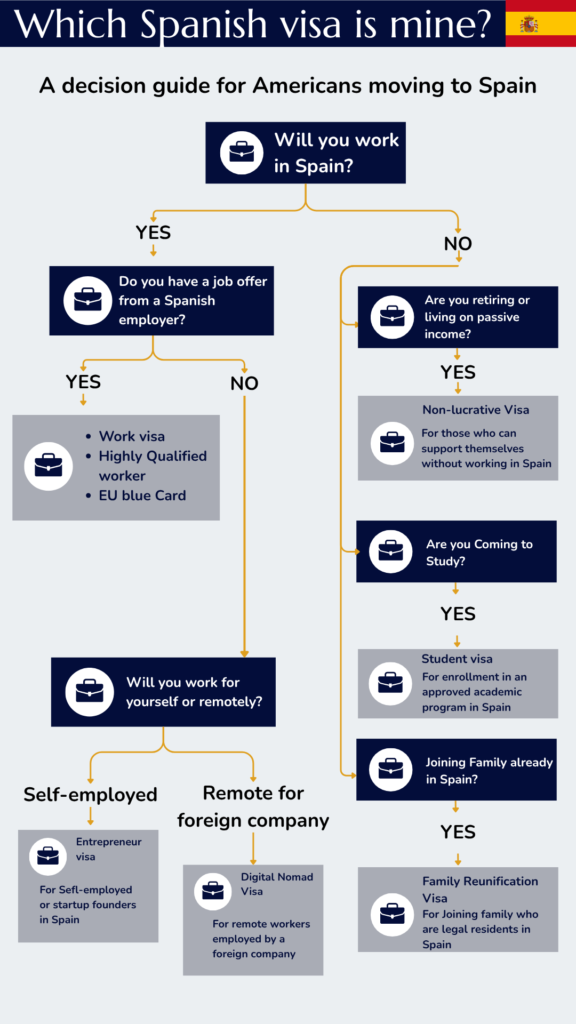
Everything downstream depends on this decision, and the wrong choice is expensive in time rather than money. These are the routes Americans actually use:
| Route | Best for | Key 2026 requirement |
| Non-lucrative visa (NLV) | Retirees and the financially independent who will not work | Around 28,800 euros a year in passive income, plus roughly 7,200 per dependent. No work permitted. Renewal now requires 183 days a year in Spain |
| Digital nomad visa | Remote employees and freelancers with foreign clients | Around 2,850 euros a month, degree or three years of experience, Spanish clients capped at 20% of income |
| Student visa | Anyone wanting to test Spain via a language or degree programme | Enrolment plus lower financial threshold; limited work permitted |
| Highly qualified professional | Executives, specialists and intra-company transfers with a Spanish employer | A qualifying job offer meeting the annual salary thresholds |
| Self-employed visa | Freelancers and business owners serving the Spanish market | A viable business plan and the required investment and means |
| Entrepreneur visa | Founders of innovative, scalable projects | A favourable ENISA report on the business plan |
Two clarifications that save Americans months. First, buying property in Spain does not give you residency; foreigners may buy freely, but the purchase and the visa are separate matters, and Spain’s golden visa route closed in 2025. Second, these routes are not interchangeable after the fact: the non-lucrative visa prohibits work, and converting out of it later is a procedure with its own conditions, so if there is any chance you will want to earn income, say so before you choose, not after.
Phase 2. Six to three months out: documents
Spanish consulates refuse more applications for paperwork defects than for substance, and Americans are especially exposed because the US document chain has two moving parts that both take time.
- FBI criminal background check: it must be the federal FBI Identity History Summary, not a state or local police check, and it must then be apostilled by the US Department of State. That apostille is the long pole in your tent; start it before anything else.
- Apostilles for state-issued documents: birth certificates, marriage certificates and similar are apostilled by the Secretary of State of the issuing state, not by the federal government. Each state has its own process and timeline.
- Sworn translations into Spanish by a translator recognised by the Spanish Ministry of Foreign Affairs. A translation certified in the US is generally not sufficient.
- A medical certificate worded to the consulate’s specification, confirming you carry no diseases with public health implications under the International Health Regulations.
- Private health insurance meeting Spanish criteria: full coverage, no co-payments, no waiting periods. American travel policies and US employer plans almost never qualify.
- Financial evidence appropriate to your route: bank and brokerage statements, pension award letters, employment or client contracts, tax returns.
Everything has a shelf life. Criminal records, medical certificates and apostilles all age, and the most common self-inflicted delay we see is a file where one document expired while another was still being obtained. Sequence them deliberately, working backwards from your intended consulate appointment.
Phase 3. Three months out: The consulate and leaving the US
Your application is filed at the Spanish consulate with jurisdiction over your state of residence, and you cannot choose a different one because its appointments are easier to get. Jurisdictions differ significantly in appointment availability and in how they interpret requirements, which is why generic checklists are only ever a starting point. Book as soon as your documents are in order, expect the visa to take weeks rather than days, and note that you must enter Spain within the validity window printed on the visa.
On the US side, three things need attention before you fly. Notify your bank and card issuers, because accounts flagged as inactive or fraudulent from abroad are a miserable way to spend your first week. Decide what ships, what sells and what stores, remembering that a container to Spain is a four to eight week sea journey and that furnishing an apartment locally is often cheaper than moving furniture across an ocean. And deal with state tax residency: leaving the country does not automatically end your obligations to your state, and several states apply demanding tests before they accept that you have gone. Ask your US accountant specifically about severing state residency, because federal advice alone will not cover it.
Phase 4. Your first 30 days in Spain
Order matters here more than speed, because each step unlocks the next:
- 1. Empadronamiento: register at your local town hall with your rental contract. Almost everything else asks for this certificate.
- 2. TIE appointment: book your fingerprint appointment (toma de huellas) within the deadline that applies to your visa, and collect your foreigner identity card weeks later. Your NIE number comes with this process.
- 3. Social Security registration where your route requires it, which is what connects you to the public health system if you are working.
- 4. Bank account: and here is a specifically American obstacle. Because of FATCA reporting obligations, some Spanish banks restrict or decline accounts for US persons, and others impose additional paperwork. Not all branches of the same bank behave identically. Ask before you queue, and bring your NIE, passport, padron and proof of income.
- 5. Utilities, internet and a Spanish phone number, all of which are easier once the first four are done.
Give yourself a temporary rental for the first month or two. Signing a long lease before you know a city’s neighbourhoods is the most common regret we hear, and Spanish leases are not casually exited.
Phase 5. Your first year: What nobody tells americans
Taxes: You now have two systems
Spend more than 183 days in Spain in a calendar year and you become a Spanish tax resident, taxed on worldwide income. You also remain a US citizen, and the United States taxes its citizens wherever they live, so you will file in both countries for as long as you hold the passport. The double taxation treaty and the foreign tax credit mechanism are what stop you paying twice, but they only work if the filings are coordinated: Spain generally has the primary right to tax you as a resident, and Spanish tax season runs later than the American one, so many US expats file an extension in the US in order to know their Spanish figures first.
Beyond the returns themselves, three obligations catch Americans repeatedly: FBAR and FATCA reporting on the US side, and, on the Spanish side, the Modelo 720 declaration of foreign assets above the reporting threshold, with its own regime for crypto. And if you hold a digital nomad visa, the Beckham Law special regime may let you pay a flat 24% on employment income up to 600,000 euros, an option that is not available to non-lucrative visa holders, with a strict deadline to elect it after registering with Social Security.
Your retirement accounts are not what you think
This is the single most expensive assumption Americans make about Spain. The favourable tax treatment of a Roth IRA is a creation of US law, and Spain does not automatically mirror it: distributions that are tax-free at home may be taxable here, and the treatment of 401(k) and traditional IRA withdrawals, of pension lump sums, and of the timing of distributions all need to be modelled before you become a Spanish tax resident, not after.
Spain also levies wealth and solidarity taxes on worldwide assets above certain thresholds, with significant regional variation, which changes the calculus for anyone arriving with substantial savings. If your move is funded by retirement accounts, get cross-border tax advice before your 183rd day, because some of these decisions cannot be undone afterwards.
Talk to Us Before Your 183rd DayYour US driver’s license will not convert
Plan for this early, because it surprises almost everyone. Spain exchanges foreign driving licenses only with countries that have a reciprocity agreement, and the United States as a whole is not among them. As a resident you may generally drive on your US license for about six months, after which you must hold a Spanish license, and obtaining one means the full process: a Spanish driving school, the theory exam, and the practical test, taken in Spain.
Americans who have driven for thirty years find themselves booking lessons, and those who leave it until month five find themselves without a car. An International Driving Permit does not solve this; it is a translation, not a license. If you are moving somewhere that requires driving, start in month one.
Healthcare, schools and everyday life
If you work in Spain, Social Security contributions give you access to the public system, which is excellent and effectively free at the point of use. If you do not work, you will hold the private insurance your visa required, and after a period of registration on the padron many regions allow access to the public system through the convenio especial, a paid monthly scheme.
Most expat families use a combination. For children, Spain offers public schools (free, entirely in Spanish or the co-official language), concertados (semi-private, modest fees) and international schools (English-curriculum, considerably more expensive); younger children absorb the language faster than parents expect, teenagers need more planning. And the everyday adjustments are real but small: shops close in the afternoon in many towns, dinner starts late, August empties the cities, and almost nothing gets done in the second half of that month.
Phase 6. Year two and beyond: From visa to passport
Your first card is not the destination, and knowing the map from the start changes the decisions you make in year one.
- Renewal: temporary permits are renewed before the Oficina de Extranjeria within the 60 days before expiry, and under the current regulation renewals cover longer periods than they used to. Absences and continuity are assessed, so plan your US trips with the renewal in mind.
- Long-term residence: after five years of legal residence you can apply for long-term residence, which is more stable and stops the renewal cycle.
- Citizenship: for US nationals the standard route is ten years of legal residence, reduced to one year for spouses of Spanish citizens and for others in specific circumstances. Spain will ask you to declare renunciation of your US nationality at the oath, and what that declaration means under US law is a separate question with its own answer, which we cover in our guide to dual citizenship in Spain.
The practical takeaway: every year of the right status counts towards this, and years spent on the wrong footing may not. That is why the visa choice in Phase 1 is worth an hour of professional advice rather than an evening of forum reading.
Start your move with Spanish immigration lawyers
Americans can and do complete this process alone. What they hire us for is the part that does not appear on any checklist: choosing the route that fits not just this year but year five, sequencing a document chain across two countries and fifty state jurisdictions, and flagging the tax and licensing consequences early enough to act on them.
- Route assessment against your income, your work plans and your long-term goal, whether that is a quiet retirement or a Spanish passport.
- Full document management: FBI check, apostilles, sworn translations, insurance review and financial evidence, sequenced so nothing expires.
- Consular application preparation for your specific jurisdiction, and the in-country process on arrival: TIE, padron, Social Security.
- Coordination with cross-border tax advisors on Beckham Law, Modelo 720 and your retirement accounts before your tax residency triggers.
- Renewals, long-term residence and, when the time comes, your citizenship application.
Whether you are twelve months out and still deciding, or already in Spain and realising the paperwork is more than you bargained for, start with a case review. Tell us your situation and we will tell you the route, the timeline and the realistic cost, before you spend a dollar on apostilles.
Book My Free Case ReviewSpeak to an attorney today
Tell us how we can be of service and one of our team members will contact you.