

The self employed visa Spain, officially the residence and self-employment work authorization (autorización de residencia y trabajo por cuenta propia)
Is the main pathway for non-EU professionals who want to settle in Spain and run their own independent activity. It is regulated by Organic Law 4/2000 and the current Immigration Regulation, Royal Decree 1155/2024, in force since May 2025, which replaced the previous regulation and simplified several procedures.
Whether you plan to work as a freelancer, open a local business or establish a professional practice, our immigration lawyers prepare your business plan file, submit the application and guide you through every step until you receive your residence card.
What is the self-employed visa in Spain?
It is a residence and work permit that authorizes third-country nationals to live in Spain while carrying out an economic activity on their own account, what Spanish law calls an autonomo. Unlike the entrepreneur visa under Law 14/2013, which requires an innovative project with technological or economic impact, the self-employed work visa Spain is designed for viable professional and business activities of any kind, even if they are traditional.
Key features:
- Initial authorization of 1 year, renewable for 4-year periods under the new Regulation.
- After 5 years of legal residence you can apply for long-term residence in Spain.
- Your residence time counts toward Spanish citizenship from the moment you register as autonomo with Social Security.
- You may work with both Spanish and international clients, with no percentage restrictions.
Who Is the Spain freelance visa for?
- International freelancers: designers, developers, consultants, marketers and translators serving Spanish and foreign clients alike.
- Small business owners: opening a coffee shop, restaurant, retail store or professional workshop.
- Liberal professionals: lawyers, architects, advisors or private physicians establishing a firm or practice in Spain, subject to professional registration.
- Investors in traditional businesses: people acquiring or launching established economic activities in the local market.
Applicants must be non-EU, non-EEA and non-Swiss citizens over 16 years old, and must not be in Spain irregularly at the time of application.
Self employed visa in Spain requirements 2026
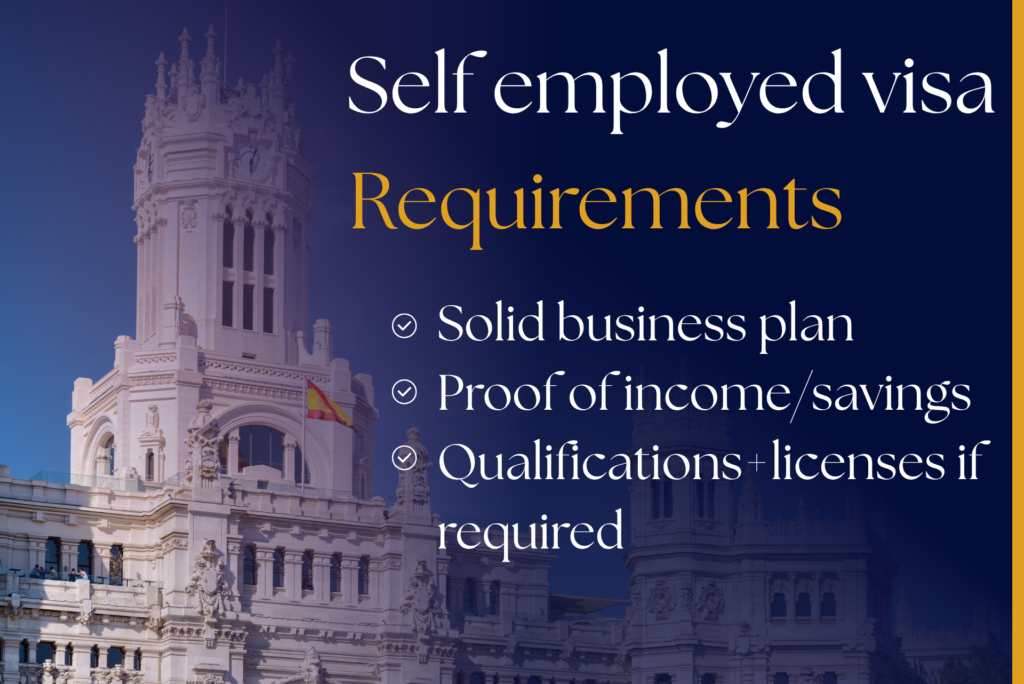
A viable business plan
The core of the application. Your plan must demonstrate the economic feasibility of the project: market analysis, investment, revenue projections and, where relevant, the potential to create employment, a factor the authorities expressly assess. A weak business plan is the most common reason for refusal, which is why our firm builds it together with you before filing.
Sufficient financial means
You must prove funds to cover the planned investment and your own maintenance. For maintenance, the reference is 100% of the annual IPREM for the main applicant, approximately 600 euros per month, around 7,200 euros per year, plus proportional additional amounts, typically between 50% and 75% of the IPREM, for each accompanying family member. In practice, the sufficiency of the investment set out in your business plan carries even more weight than the maintenance minimum.
Professional qualifications and licenses
Evidence of the training or experience required for your activity. For regulated professions such as law, medicine or architecture, you must prove the corresponding qualification recognition and professional registration (colegiacion). If your activity requires municipal licenses or sector authorizations, you must show you have applied for them.
Health insurance and clean criminal record
Private health insurance with full coverage in Spain, and no criminal record in Spain or in the countries where you have resided during the last 5 years, documented with apostilled and officially translated certificates.
Required documents
- Official application form EX-07.
- Full passport in force.
- Apostilled and translated criminal record certificate.
- Private medical insurance valid in Spain.
- Business plan and proof of financial resources.
- Academic qualifications, proof of experience and professional registration where applicable.
- Lease contract or property title for the premises, if the activity requires one.
- Municipal licenses or sector authorizations, or proof of having applied for them.
All foreign documents must be legalized or apostilled and accompanied by a sworn translation into Spanish.
How to apply for the self employed visa in Spain step by step
- Step 1. Eligibility review and business plan preparation with your lawyer.
- Step 2. File the application at the Spanish consulate of your country of residence. The visa and the initial residence and work authorization are requested together.
- Step 3. Resolution. Processing typically takes around 3 months depending on the consulate.
- Step 4. Once approved, collect your visa and enter Spain within its validity period.
After arrival: Autonomo registration and your residence card
Within the deadlines set after your arrival you must register with the Spanish Social Security under the self-employed regime (RETA) and apply for your foreigner identity card (TIE). New autonomos benefit from the reduced flat-rate Social Security contribution, around 87 euros per month during the first year, a significant saving while your business takes off. From the moment you register, your residence clock starts running for renewals, long-term residence and citizenship.
Self-employed visa vs entrepreneur visa vs digital nomad visa
| Criterio | Resumen |
| Self-employed visa (this page) | Any viable independent activity, traditional or not. Business plan required. IPREM-based means. Spanish clients allowed without limits. |
| Entrepreneur visa (Law 14/2013) | Innovative project with technological or economic impact, validated by ENISA. Faster track but far stricter on innovation. |
| Digital nomad visa (Law 28/2022) | Remote work for foreign companies or clients. Income based on 200% of the SMI. Spanish clients capped at 20% of income. |
Not sure which permit fits your situation? Choosing the wrong route is the most expensive mistake at this stage. Our lawyers compare the three options against your real project before recommending one.
Speak to an attorney today
Tell us how we can be of service and one of our team members will contact you.