

Renewal of your residence card in Spain: the 60-day window, documents, timelines and what changed in 2026. Do not risk your status.
You have done this before. You have the card, you know what a cita previa is, and you are here because a date is approaching and something feels different this time. It is. The immigration regulation changed in May 2025, renewal durations are not what they were, income and insurance criteria are being applied more strictly than in your first application, and appointment availability in the main provinces has become the real deadline rather than the legal one.
This page is the short version for people who already know the long one: when to file, what has changed, what gets renewals refused, and where we step in.
Which renewal do you actually need?
Start here, because most of the confusing advice online comes from mixing up two different procedures with different authorities and different timing. Find yourself below.
Renewing a temporary residence authorisation
This is you if you hold a temporary permit: non-lucrative, digital nomad, work or self-employment, student, family reunification, family member of an EU citizen, or an arraigo authorisation. Here the authorisation itself expires, not just the plastic. You renew it before the Oficina de Extranjeria, the file is assessed on whether you still meet the conditions that justified the original permit, and the ordinary window is the 60 days before your expiry date. This is the route most readers of this page are on.
Renewing the card of a long-term Residence
This is you if you hold long-term residence (residencia de larga duracion), typically after five years. Here the distinction matters enormously: your authorisation does not expire, only your physical card does, and what you are doing is a card renewal rather than a permit renewal. It is handled through the National Police rather than the Oficina de Extranjeria, and the practical timing rules differ, with some offices declining to process the renewal until after the card’s expiry date.
If you have read conflicting advice online about whether to apply before or after expiry, this is the source of the contradiction: two different procedures being described as one. Confirm which of the two you are in before booking anything, because filing at the wrong moment is a wasted appointment in a system where appointments are the scarce resource.
When renewal is not the right move
Sometimes the correct answer is not to renew at all. If you have completed five years of legal residence, you may be entitled to long-term residence, which is more stable, carries broader rights and stops the renewal treadmill. We regularly meet clients who have renewed a temporary card two or three times without realising they qualified for the permanent option years earlier.
Equally, if your circumstances have changed, from studies to work, from employment to self-employment, from arraigo to an ordinary work and residence authorisation, the right procedure is a modification rather than a renewal, and choosing modification at the right moment often resets your position more favourably than another year of the same card. This is the single most valuable ten minutes of advice on this page, and it costs nothing to ask before you file.
When to apply: The 60-day window and the 90-Day grace period
For temporary authorisations, Spanish law gives you two overlapping windows, and the difference between them is the difference between routine and stressful.
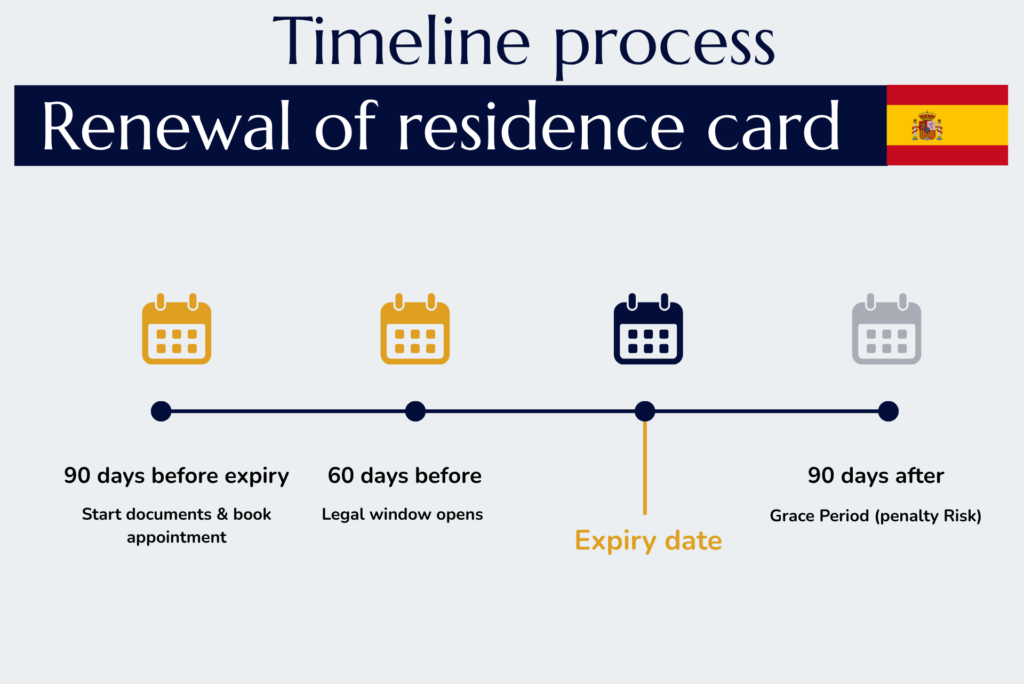
- The ordinary window: the 60 calendar days immediately before your card’s expiry date. File here and the renewal proceeds as a matter of course.
- The grace period: up to 90 calendar days after expiry. Your right to renew survives, but you expose yourself to an administrative penalty and to complications with travel, contracts and employment while your status is unclear.
Now the part the legal texts do not tell you: in Madrid, Barcelona, Malaga, Valencia and Alicante, appointment slots are the true constraint. Securing a cita previa can take weeks, and the calendar does not care that your legal window is open. Our standing instruction to clients is to begin at 90 days before expiry: gather documents, confirm the route, and secure the appointment, so that filing inside the 60-day window is a formality rather than a race. People who wait for the legal window to open are the ones who discover that the next available slot falls after their card expires.
What happens if your card has already expired
Do not panic, and do not wait any longer. Within the 90 days following expiry you can still file, and the permit does not automatically vanish with the plastic; you may face an administrative penalty and some friction, but the situation is recoverable and we handle these files regularly. What you must not do is let the grace period lapse: past that point your right to renew can be lost, and you may be looking at starting over under rules that are not the ones you originally qualified under. If you are reading this already past your expiry date, that is the call to make today rather than tomorrow.
Your status while you wait
Here is the reassurance most people are looking for and few pages state clearly. When you file your renewal in time, your legal status is automatically extended until the administration issues a decision, so the months between submission and resolution are not a period of irregularity. You keep your right to reside, and generally to work under the same conditions, while the file is processed, with your submission receipt as evidence. Travel during this period requires more care, particularly re-entry, so speak to us before booking flights rather than after.
Book My Renewal Slot ReviewDocuments for your residence card renewal
A renewal is an exercise in proving continuity, not in starting over, and the file is smaller than your first application. The core set:
- The official application form for your permit type, marked as a renewal, with the correct box for your first or subsequent renewal.
- Your full passport, valid, plus a copy of your current TIE.
- Proof of the corresponding fee (Modelo 790, with the code that applies to your procedure and stage).
- An updated certificado de empadronamiento, matching the address the administration has on record for you.
- Evidence that the conditions of your permit still hold: employment contract and Social Security records, self-employment registration and tax filings, proof of funds and their origin, enrolment for students, or the family relationship documentation as applicable.
- Health cover valid in Spain: Social Security through employment, or a private policy meeting the current criteria.
- For families, evidence that dependent children are enrolled in school.
Two document traps we see constantly. First, insurance: policies with co-payments, waiting periods or partial coverage are being rejected, and a policy that passed at your first application may not pass now. Second, expiry: certificates and criminal records have validity windows, and files fail because one document aged out while another was being obtained. Sequence is as important as content.
The renewal process, step by step
- 1. Route and eligibility check: renewal, modification or long-term residence, and confirmation that your absences and continuity support the file.
- 2. Document assembly, started at around 90 days before expiry.
- 3. Filing with the Oficina de Extranjeria, generally electronically through your legal representative, within the 60-day window.
- 4. Processing. Timelines vary by province and commonly run to several months; your status remains extended throughout.
- 5. Resolution. Once favourable, you book the fingerprint appointment (toma de huellas) at the National Police.
- 6. Card collection, typically several weeks after fingerprints, at the same station.
The total elapsed time from filing to holding the new card is routinely measured in months rather than weeks. This is not a sign that something has gone wrong; it is the normal rhythm, and it is precisely why starting early matters more than anything else on this page.
Why renewals get refused
Refusals almost never come out of nowhere. In our caseload they cluster around the same causes, and every one of them is visible in advance to someone who knows where to look.
- Absences: prolonged time outside Spain is the most straightforward refusal ground there is, and the limits differ between temporary permits and long-term residence. If you have been away more than you probably should have been, say so at the first consultation rather than hoping the file officer does not add up the stamps. There are far more options before filing than after a refusal.
- Failing to meet the current economic threshold, which may have risen since your original application, or proving it with documentation that no longer satisfies the office.
- Health insurance with co-payments, exclusions or waiting periods.
- A padron that does not match your actual address, or was never updated after a move.
- Loss of the underlying condition: employment ended, studies abandoned, the family relationship changed, the business inactive.
- Filing outside the window, at the wrong office, or under the wrong procedure for your permit type.
A refusal is not necessarily the end. It can be challenged through administrative review and, if needed, before the contentious-administrative courts, and a response that addresses the actual grounds rather than resubmitting the same file succeeds more often than people expect. It is simply a far more expensive way to arrive at the same destination.
What changed in 2026
If your last renewal was two or more years ago, three things are different. The Immigration Regulation approved by Royal Decree 1155/2024 came into force on 20 May 2025 and replaced the previous regulation in full, which means the framework your earlier renewals were processed under no longer exists.
Renewal durations were extended, with renewals of up to four years available where the previous regime granted two, so your next card may cover a considerably longer period than your last one. And the practical side has tightened: income evidence, insurance criteria and address checks are being applied more strictly, while appointment availability has become the binding constraint in the busiest provinces. The net effect is favourable for well-prepared files and unforgiving for improvised ones.
Renew with our immigration lawyers
Renewals are the procedure clients most often try alone, and the one where the cost of a small mistake is most disproportionate: a missed window, an insurance policy that no longer qualifies, or a routine renewal filed when long-term residence was already available. None of those are complicated problems. They are timing and diagnosis problems, which is exactly what a lawyer is for.
- Deadline management: your 90-day and 60-day dates calendared from the day we open your file, with the appointment secured before the window opens.
- Route diagnosis: renewal, modification or long-term residence, decided on your actual years and circumstances rather than habit.
- Document review against current criteria, including your insurance policy and income evidence, before anything is submitted.
- Filing and follow-up with the Oficina de Extranjeria, your fingerprint appointment and card collection.
- Absence and continuity assessment before filing, and appeal representation if a refusal arrives.
Send us your card’s expiry date and your permit type, and we will tell you which procedure you need, which window applies to you, and what to start collecting this week. If your card has already expired, contact us today: the grace period is finite and it is running.
Book My Eligibility ReviewSpeak to an attorney today
Tell us how we can be of service and one of our team members will contact you.