

If you are living in Spain without a valid residence permit, arraigo is very probably the route back to legal status.
And it is designed to be used from inside the country: no return to your home country, no consulate, no waiting abroad. What most people looking into it do not yet know is that the rules changed.
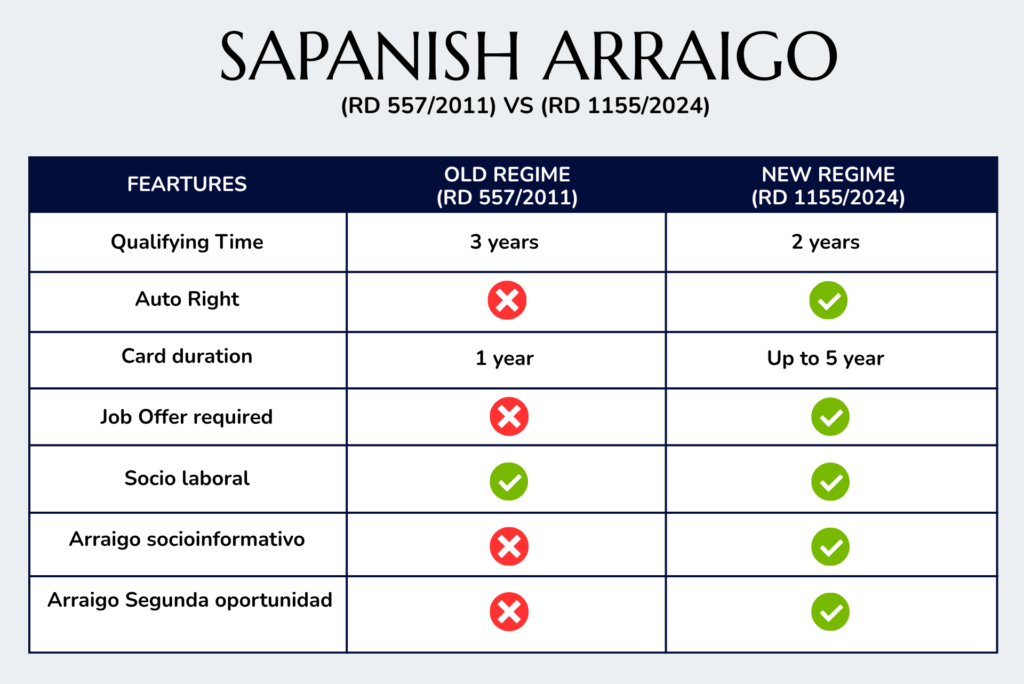
Since 20 May 2025, Royal Decree 1155/2024 has replaced the old regulation entirely: there are now five types of arraigo rather than three, and the general residence requirement dropped from three years to two. If you have been counting to three, you may already qualify.
What is arraigo and who can apply?
Arraigo, literally roots, is a temporary residence authorisation granted on exceptional grounds under article 31.3 of Organic Law 4/2000 and developed by the current Immigration Regulation. It exists for one purpose: to give legal status to people who are already part of Spanish society, through time, work, family or study, but who lack the paperwork to prove it in the ordinary way.
In broad terms, you may be eligible if all of the following describe you:
- You are a national of a country outside the EU, the EEA and Switzerland.
- You are currently in Spain, in an irregular administrative situation or with a permit you were unable to renew.
- You have been in Spain continuously for at least two years (with important exceptions: arraigo familiar requires no minimum stay, and the second chance route is based on your previous permit rather than a stay count).
- You have no criminal record in Spain, nor in your countries of residence during the previous five years.
- You have no entry ban in force for Spain or the Schengen area.
Every arraigo authorisation, once granted, carries the right to work, which is what makes this figure so valuable: it does not merely legalise your presence, it lets you build a life you can document from that point forward.
The 5 types of arraigo in Spain (2026)
The modalities are no longer separated by how long you have been here, since most now share the same two-year threshold. What separates them is what you can prove. Choosing correctly is the first strategic decision of your case, not an administrative detail.
| Type of arraigo | Minimum stay in Spain | Core condition |
| Social | 2 years | Family link with a legal resident, or a favourable social integration report from your Autonomous Community, plus proof of economic means |
| Sociolaboral | 2 years | A job offer or employment contract meeting the minimum wage or collective agreement salary, with at least 20 hours per week |
| Socioformativo (training) | 2 years | Enrolment, or a commitment to enrol, in regulated employment-related training |
| Familiar | None | Specific family circumstances involving minors or dependants |
| Segunda oportunidad (second chance) | Not stay-based | Having held a residence authorisation in the previous two years that could not be renewed |
Arraigo social
The broadest route, and the one most applicants end up using. It requires two years of continuous stay in Spain, no criminal record, and proof of integration into Spanish society, evidenced either through family ties with a legal resident or through a favourable social integration report issued by the Autonomous Community where you live (in Catalonia this is known as the informe de arraigo).
You will also need to demonstrate sufficient economic means for your support. An important update that outdated guides get wrong: arraigo social no longer requires you to prove a history of informal work, a requirement that used to sink otherwise solid applications, and it no longer requires a mandatory employment contract. That figure is now a separate modality.
Arraigo sociolaboral (formerly arraigo laboral)
If an employer is ready to hire you, this is your route. Arraigo laboral as it existed before the reform no longer exists; it was replaced by arraigo sociolaboral, which rests on a job you are taking up rather than on work you have already performed, a far more attainable standard.
You need two years of continuous stay and an employment contract guaranteeing at least the statutory minimum wage or the applicable collective agreement salary, for a minimum of 20 hours per week. The old requirement to prove undeclared employment through a labour court judgment or an inspection report, which made the previous version of this route almost unusable, is gone.
Arraigo socioformativo (training)
Created by the reform for applicants who are willing to train. It requires two years of continuous stay plus enrolment, or a firm commitment to enrol, in regulated training linked to employment. On completing the training, the permit converts into a full work authorisation. One warning we give every client considering this route, because it is rarely stated clearly elsewhere: this modality does allow you to work, but only as an employee and with a weekly cap of around 30 hours. If your plan is to regularise in order to work full time, this is not your route, and choosing it by mistake is an expensive detour.
Arraigo familiar
The fastest route where the family relationship qualifies, because it requires no minimum period of stay at all and carries the lightest evidentiary burden. It was, however, narrowed by the reform to specific situations involving minors and dependants: family members of Spanish nationals now fall under a separate regime with its own rules. If you are the parent or guardian of a minor, or the relative of a person with a recognised disability, this route deserves a careful look before any other.
Arraigo de segunda oportunidad (second chance)
The genuinely new figure created by the reform, and the one that rescues a profile the old system abandoned: people who held a valid residence authorisation within the previous two years and lost their legal status because they could not renew it. Instead of waiting two more years in irregularity, this route restores legality directly. If you had a student permit, a work permit or another authorisation that lapsed, do not assume you are back to square one, and do not act on a forum post: bring us the dates and let us check the current position of this route before you plan anything around it.
Arraigo requirements in Spain
Beyond the modality-specific conditions above, every arraigo file rests on the same foundations: non-EU nationality, presence in Spain, a clean criminal record in Spain and in your countries of residence over the last five years (with foreign certificates apostilled or legalised and officially translated), no entry ban in force, and, above all, a documented and continuous stay.
Proving two years of continuous stay
This is where cases are won and lost, and it is what generic guides skip. Extranjería does not accept a single document as proof of two years; it looks for a coherent trail across the whole period. Your padron registration is the backbone, but gaps in it are common and are not fatal if you can bridge them: medical records and appointments, school enrolment for children, bank movements, remittance receipts, utility bills, rental contracts, transport cards, payslips or delivery-platform records, membership of associations, and dated correspondence all contribute.
The rule of thumb we apply is simple: at least one dated document, from an independent source, for every few months of the period, forming an unbroken chain. Start collecting before you file, not after Extranjería asks.
The social integration report
For arraigo social, the favourable social integration report from your Autonomous Community is usually the decisive document. It assesses your ties to the community: your time in Spain, your accommodation, your family links, your knowledge of Spanish (and of the co-official language where one exists), any training you have completed, and your participation in local networks. Criteria and waiting times differ significantly between regions, which is why the same profile can succeed comfortably in one Autonomous Community and struggle in another. We prepare clients for this report specifically, because it is graded on presentation as much as on facts.
Talk to an Immigration LawyerHow to apply for arraigo: Process and timelines
The application is filed in Spain, from Spain, before the Immigration Office (Oficina de Extranjeria) of the province where you live. In outline:
- 1. Case assessment: identify the correct modality and confirm your two-year period is documentable. This is the step that determines everything after it.
- 2. Evidence assembly: your continuity file, criminal record certificates with apostille and sworn translation, passport, padron, and the modality-specific documents (contract, enrolment, family records, or the integration report).
- 3. Integration report request, where applicable, since regional waiting times can be the longest single item in your calendar.
- 4. Filing with the payment of the corresponding fee, generally submitted electronically through your legal representative.
- 5. Resolution. If favourable, you have a set period to apply for your foreigner identity card (TIE), register your fingerprints and, where you will be working, register with Social Security within the period established after the authorisation is granted.
Timelines depend on the province and on whether an integration report is involved. Realistically, plan in months rather than weeks, and understand that the preparation phase, which you control, is usually longer than the administrative phase, which you do not.
What happens after your first year
Arraigo authorisations are generally granted for one year, extendable for one further year, with arraigo familiar operating on its own longer terms. At the end of that first year you face a choice that most applicants do not realise they have, and it matters more than the application itself.
You can extend the arraigo for another year, which keeps you legal but leaves you in the exceptional-circumstances regime. Or you can modify your status into an ordinary residence and work authorisation, which is the stronger move whenever you meet its requirements: it consolidates a stable position, it is granted for a longer period, and it puts you on the standard track towards long-term residence in Spain after five years of legal residence, and eventually towards Spanish nationality, after two years for nationals of Ibero-American countries and ten for most others. Planning that transition should begin months before your first card expires, not in the final weeks.
Why arraigo applications get refused
Most refusals are not about bad faith or bad luck. In our experience they cluster around the same avoidable errors: choosing the wrong modality for the profile, gaps in the documentary chain of continuous stay, padron registered too late to cover the full period, criminal record certificates missing an apostille or a sworn translation, a contract that does not meet the salary or weekly hours threshold, an integration report requested too late, expired documents by the time of filing, and applications for arraigo social submitted on the basis of the old three-year rule or the old informal-work requirement. Each of these is a preparation problem, which is another way of saying each of them is preventable.
Check your arraigo eligibility with our lawyers
Arraigo is the most human part of Spanish immigration law and, since the 2025 reform, one of the most technical. Two people with almost identical lives can end up on entirely different routes, and with entirely different outcomes, depending on which modality they file under and how their two years are documented. That assessment is what we do first, and we do it before anyone pays for a full case.
- Eligibility review: which of the five modalities fits your situation, and whether your period of stay is documentable today or needs building first.
- Evidence strategy: a personalised list of documents that closes the gaps in your two-year chain.
- Integration report support: preparation and follow-up with your Autonomous Community.
- Full filing and representation before the Immigration Office, in English and Spanish, with your TIE appointment and Social Security registration handled afterwards.
- Forward planning: your renewal or your modification to an ordinary work and residence permit, with the long-term residence and nationality clock in view from day one.
If you have been in Spain for two years or more, or you lost a permit within the last two years, you may be closer to legal status than you think. Book your eligibility review and find out where you actually stand.
Talk to an Immigration LawyerSpeak to an attorney today
Tell us how we can be of service and one of our team members will contact you.